Case study 2026 Web app
TAN攤
A whole trip’s expenses, settled on the ride home.
- My part
- Product definition, interface design, front end, database and permissions, testing. All of it, solo.
- Period
- From July 2026, still being updated
- Stack
- React, Supabase (PostgreSQL), Cloudflare Turnstile, Vercel
- Status
- Live, in Chinese and English, free for now
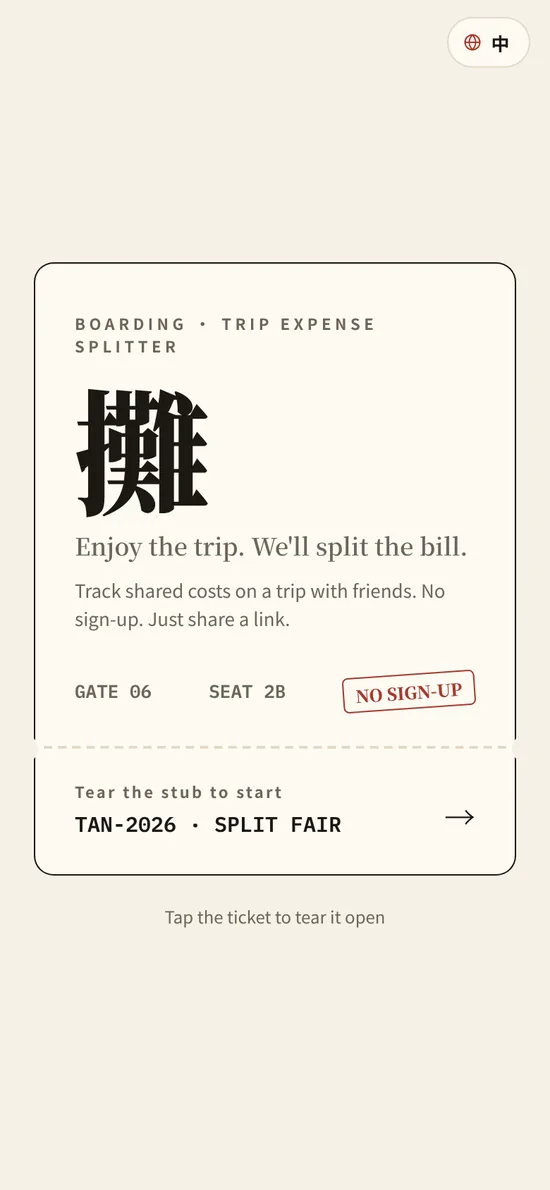
In one minute
- Problem
- On a trip, everyone pays for different things. Back home, each person remembers half of it, and some of it was in yen.
- Approach
- One shared ledger. Friends join from a link by picking their name, log costs as they happen, and at the end see who pays whom.
- Result
- Live in Chinese and English. In November 2026 it went through a security review and a hands-on acceptance test in production.
- Not yet
- Needs a connection. Doesn’t move money. Identity lives in the browser, so a new phone needs a recovery link saved in advance.
Where it started
TAN started with my own trips. One person paid for breakfast, another for the train, someone else covered dinner. Back home, everyone remembered half of it, and we went back and forth in the group chat. With yen mixed in, it usually ended with “never mind”, and somebody quietly lost out.
What I wanted was one ledger everyone fills in as things happen, and at the end a clear answer for each person: who to pay, and how much. Full-featured accounting apps already exist.
What follows is in the order it was built: what each stage added, what went wrong, how it was decided, and how I checked it worked.
01July 2026
Getting the sums right first
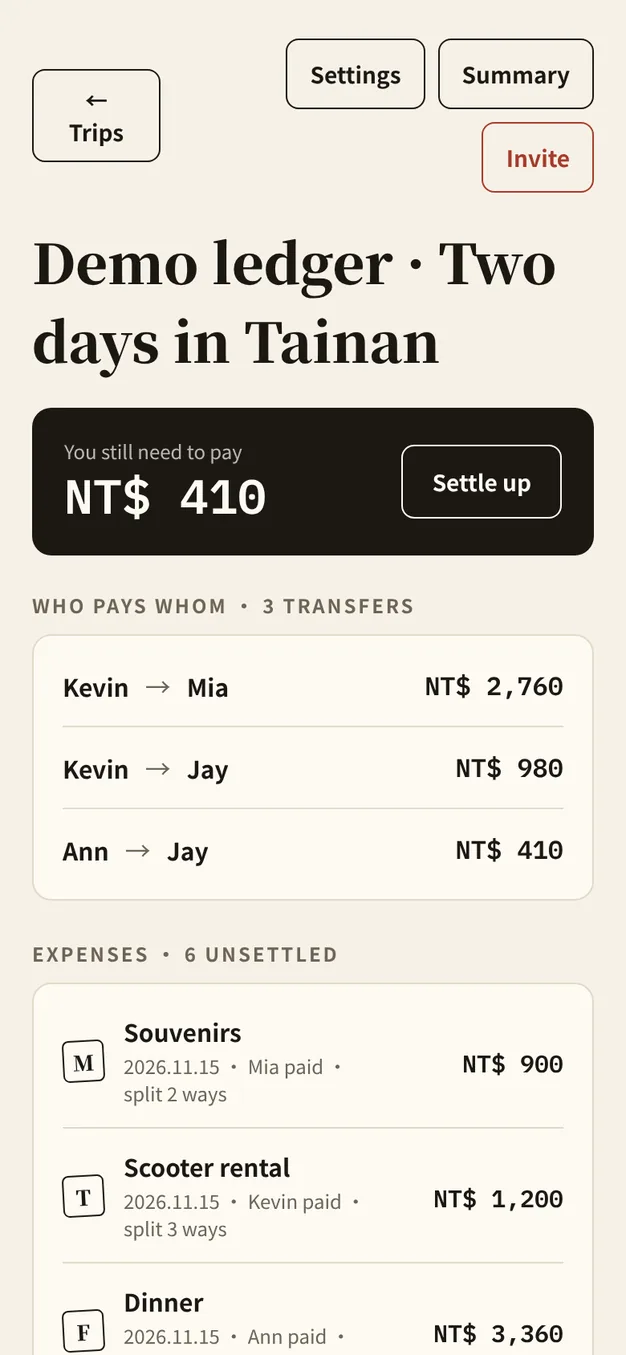
What got builtThe v4 prototype: interface, logging, even and custom splits, settle-up, all on a single phone. The core had to be right before anything was shared.
Key decision
Pairing up the money so nobody feels short-changed
In the end everyone wants one thing: who do I pay and how much, or who pays me.
- Considered
Settling each expense separately is the obvious way, but a trip has dozens of them and nobody wants that many transfers. At the other end, guaranteeing the mathematical minimum gets expensive quickly as the group grows.
- Decision
Work out each person’s balance, then pair the person with the most left to pay with the person due the most, again and again. Never more transfers than people minus one, predictable, and easy to check by hand.
- Trade-off
It doesn’t guarantee the mathematical minimum; some combinations end up a transfer or two above it.
Each person’s balance
- AnnNT$ +1,200
- KevinNT$ −500
- MiaNT$ −400
- JayNT$ −300
Transfers after pairing
- Kevin pays AnnNT$ 500
- Mia pays AnnNT$ 400
- Jay pays AnnNT$ 300
02August 2026
From one phone to a ledger everyone shares
What got builtA cloud database: genuinely shared ledgers, invite links, live sync between members. Each foreign-currency expense keeps the rate from the moment it was logged, and removing a member first checks whether they still have expenses.
Key decision
No sign-up: open a link and you’re in
Splitting only works if everyone is in the same ledger. If one person can’t be bothered to install or register, the ledger is never complete.
- Considered
Email and password, a social login, or no login at all. The first two lose people at the very first step.
- Decision
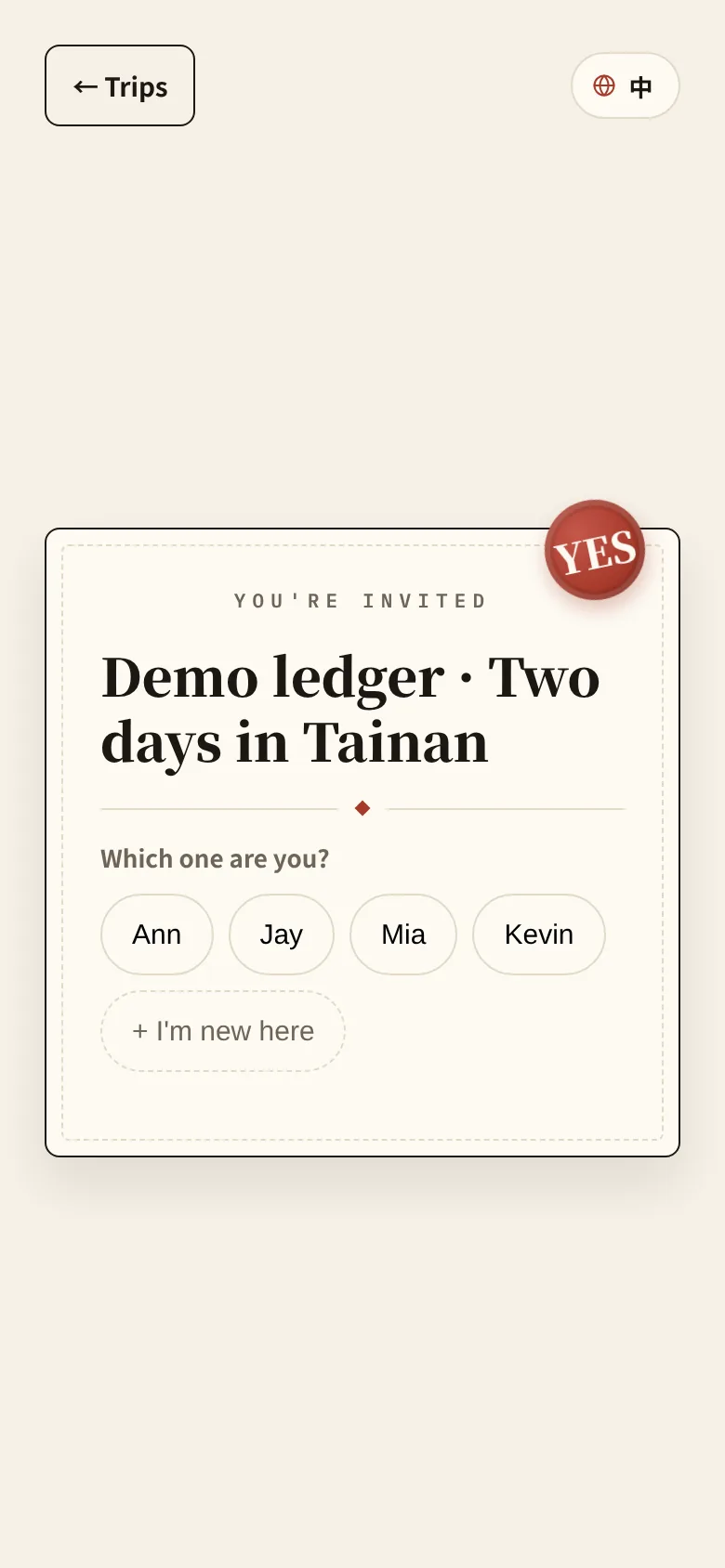
A web app: open the invite link a friend sends, pick your name, and you’re in.
Behind it is anonymous sign-in, so each device has its own identity. To stop scripts creating identities in bulk, the first visit goes through Cloudflare Turnstile, which usually finishes in the background unnoticed.
- Trade-off
Identity lives in the browser. A new phone, or cleared site data, and you’re a new person. The next two stages deal with that.
- Checked
On the live site: four test identities each opened TAN for the first time, verification passed in the background every time, and joining by link took one step.
03September 2026
Real use: friends arrive from a chat app
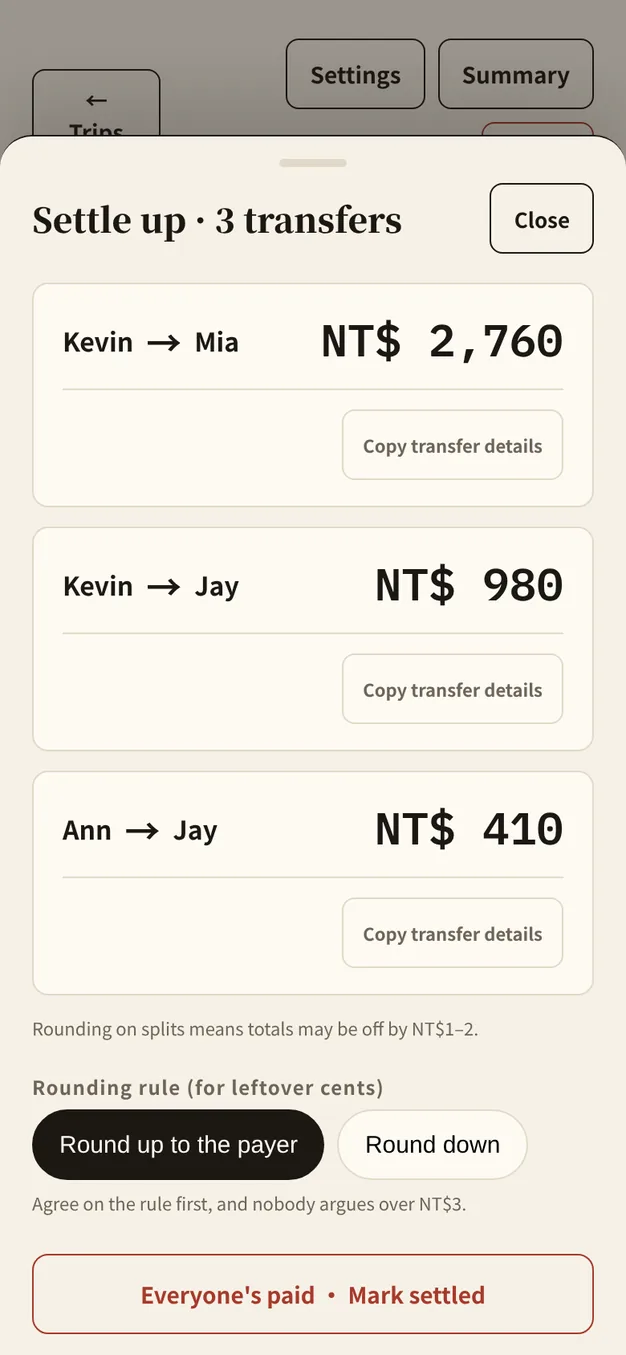
What got builtAn in-app-browser warning and an add-to-home-screen guide. Settle-up redesigned, with a note that even splits may be off by a dollar or two.
Key decision
The ledger that “disappeared” in another browser
Invite links are mostly opened inside LINE, Facebook or Instagram, and the data in those in-app browsers can’t be carried to another browser.
- Decision
When opened in an in-app browser, TAN first suggests switching to Safari or Chrome, and shows how to add it to the home screen, so it opens as the same identity every time.
- Trade-off
One more step the first time.
Key decision
Agree the rounding rule first
When an even split doesn’t divide cleanly, the odd dollar is what makes people uncomfortable.
- Decision
The group picks a rule first: round up in favour of whoever paid, or round down, and the screen says totals may be off by a dollar or two. Dates carry the year, so a trip over New Year doesn’t get mixed up.
- Checked
In a test ledger, NT$900 split evenly plus ¥3,000 (about NT$645) split evenly came to NT$772.5 for one person: 773 rounding up, 772 rounding down.
04October 2026
Polish: languages, the summary card, recovery and motion
What got builtChinese and English. The trip summary card saves as a story-sized image. Recovery links. A motion redesign. The background blur that caused stutter removed. The Chinese interface dropped wording that sounded like debt.
Key decision
Getting a ledger back after losing your identity
The cost of having no accounts needed a fix, without bringing accounts back in through the side door.
- Decision
Everyone can create a personal recovery link and save it. Opened on a new device, it brings their ledgers back. The server stores only a hash of the link.
- Trade-off
People have to remember to save it. Without it, a new phone means asking for a fresh invite.
- Changed later
November’s security review found the link restored everything immediately and could be reused. Now it lists which ledgers it will bring back, waits for a confirmation, and works once.
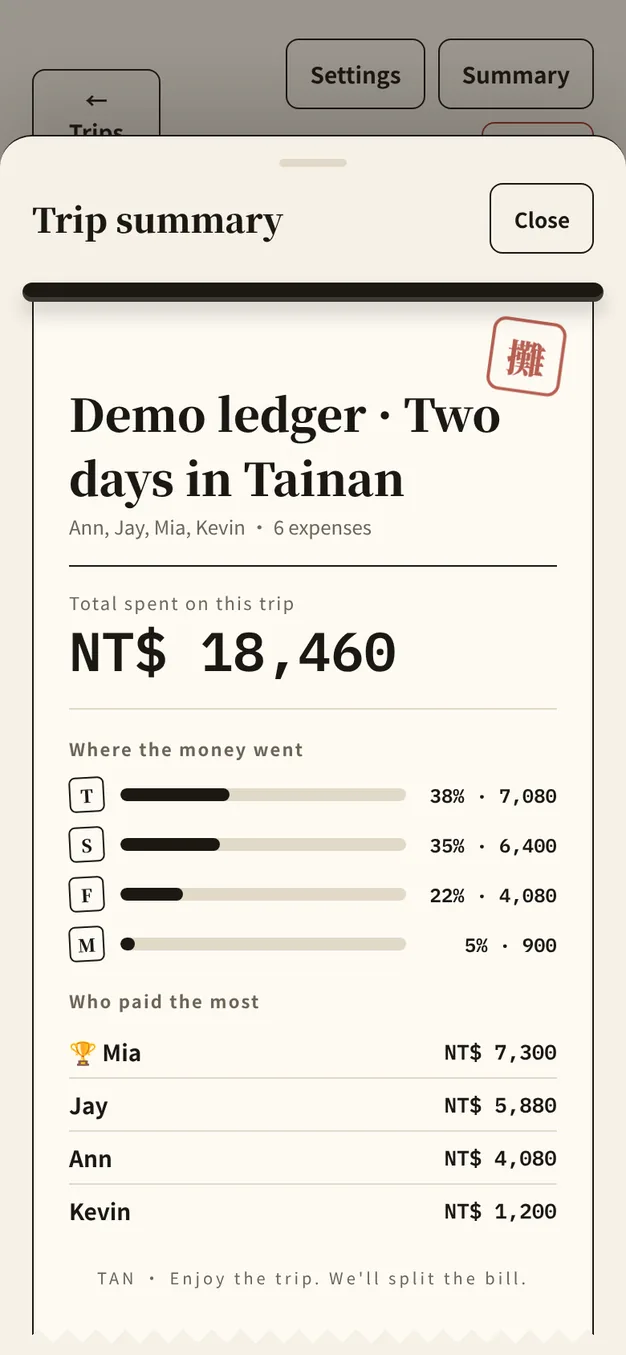
Interface
A ledger is a ticket
A ledger is a journey, so it opens with a boarding pass you tap to tear. A new ledger is printed and stamped; once every transfer is done, the summary card is stamped “settled”.
- Decision
Motion is continuous and springy, so screens feel picked up and put down like paper.
The wording follows the same idea: the interface says “you still need to pay” and “still coming to you”. Splitting with friends shouldn’t sound like debt collection.
- Trade-off
The first version blurred the background behind sheets, which made scrolling stutter. The blur went; the motion stayed.
05November 2026
A security review, then testing in production
What got builtA full security review and the fixes it led to. Member management: the creator can remove someone, and the invite code changes automatically. Then a hands-on acceptance test on the live site.
Key decision
One shared ledger: who can do what
Everyone needs to add expenses and fix their own mistakes. Removing people, changing the invite and deleting the ledger are another matter.
- Decision
Permissions are enforced in the database; hiding buttons is not relied on. Every request can only see and change ledgers it has access to, and management actions are checked on the server against the ledger’s creator.
Names are deliberately flexible: anyone can pick their name again, so a wrong pick can be fixed without help. Permissions follow the device, not the name.
- How it was reviewed
On an isolated copy of the database, each role tried to do things it shouldn’t, step by step, and a reviewer who hadn’t worked on the code checked the results independently. Every fix had a way to roll back, and the live data was backed up first.
- Trade-off
Free names mean someone could pick another person’s name, but picking the creator’s name still doesn’t grant the creator’s permissions.
- Checked
Afterwards a test run on the live database used temporary accounts and was rolled back as a whole; real ledgers were compared table by table and matched exactly.
What the review found and fixed
A member could make themselves the owner, then delete the ledger
- Possible effect
- Someone else’s ledger deleted
- Fix
- Owner and invite code changeable only by the creator
- How it was checked
- The same steps are now refused
A member could change the invite code
- Possible effect
- Everyone else’s invite link broken
- Fix
- As above
- How it was checked
- As above
Invite codes used an ordinary random generator
- Possible effect
- Guessable in principle
- Fix
- Cryptographic randomness
- How it was checked
- 20,000 codes, no repeats, distribution test passed
Requests without sign-in carried permissions they didn’t need
- Possible effect
- A larger surface than necessary
- Fix
- Unneeded function and table permissions revoked
- How it was checked
- Such calls are now refused; app behaviour unchanged
Recovery links were reusable and restored without asking
- Possible effect
- A leaked link stayed valid
- Fix
- Confirm first, single use
- How it was checked
- A second use reports the link has expired
Ledgers with unsettled expenses couldn’t be deleted (a bug)
- Possible effect
- Creators couldn’t delete
- Fix
- Deletion order fixed
- How it was checked
- After deletion, members, expenses and access are all gone
Each issue was reproduced on the isolated copy first, then checked again with the same steps after the fix. The review followed the chapters of OWASP ASVS (the OWASP Application Security Verification Standard), but it isn’t a certification and doesn’t mean nothing else is left. Code and database specifics stay private.
Key decision
The last step: walk it like a user
Automated tests prove the code does what it was written to do, nothing more.
- Decision
Four test identities played the creator, a member, someone on a new phone and a stranger, in an isolated test ledger: create, invite, log, foreign currency, settle, summary card, remove a member, recover, leave and delete.
- Changed later
It caught something the scripts missed: a removed member who came back with a new invite kept the name stored on their phone, instead of being asked again. Fixed the same day, then tested again.
And a small thing on phones: the last character of an expense’s description could wrap onto a line of its own.
- Checked
After the test ledgers and identities were deleted, the real ledgers were compared once more and matched the state before testing.
What it’s built on
- Front end
- React 19 and Vite, deployed on Vercel. A web app that can be added to the home screen.
- Data
- Supabase: PostgreSQL with Row Level Security, live sync between members of a ledger.
- Identity
- Anonymous sign-in, with Cloudflare Turnstile against automated mass sign-ups.
- Database changes
- 15 recorded changes; recent ones were tested on an isolated copy first, each with a way to roll back.
Current limits
- Needs a connection; it doesn’t work offline.
- It works out the money but never moves it.
- Identity lives in the browser; a new phone needs a recovery link saved in advance.
- Names are free to pick, so someone could choose another person’s name.
- Never more transfers than people minus one, but not guaranteed to be the minimum.
- Free for now; whether it will ever charge isn’t decided.
Next case study